
Introduction
Retail consumers are bombarded daily with promotional messages from numerous brands. The generalized discounts, along with repeated promotional messaging, can easily be ignored by consumers. To catch the attention of consumers, retail stores should adopt a more customized promotional strategy.
This is where retail messaging automation can help. By combining RCS messaging and WhatsApp, retail stores can send personalized offers, announce new arrivals, share product recommendations, remind customers about abandoned carts, and promote seasonal sales through automated communication.
RCS messaging for retail stores enables businesses to create interactive messages with rich media, product images, suggested actions, and branded business information on supported devices. WhatsApp marketing for retail businesses provides a familiar messaging channel for sharing offers, answering customer questions, and supporting conversations throughout the shopping journey.
Retailers based in India could leverage these channels for engagement at physical stores, on online shopping websites, and on omnichannel shopping platforms. Preference details, purchasing history, and interaction during campaigns could be leveraged by businesses to help make their messaging relevant.
This guide would take an insight into the working of RCS & WhatsApp, personalized retail campaigns, and messaging solution choice for the business.
What Is Retail Messaging Automation?
Messaging automation in retail refers to the utilization of technology and data of the customer to automatically communicate with the customer in accordance with their behavior, preference, schedule of events, or marketing campaign strategy.
Rather than sending each promotional message individually, the retailer can utilize an automated process where the proper message will be communicated when the client satisfies a particular criterion.
A clothes store, for instance, can send out an arrival announcement to clients who wish to receive such updates. The supermarket can communicate to customers about its upcoming discount on weekends, while the e-commerce site can send a legal reminder to the customer’s shopping cart.
Examples of uses of the services include:
- Recommended products based on the customers’ information.
- Information about sales that occur during special occasions and festivals.
- Updates regarding the loyalty programs.
- Birthday or anniversary discounts and deals.
- Products back in stock notification.
- Delivery and order confirmation.
- Prompts for items left in the online shopping cart.
- Feedback from customers.
Through the use of RCS and WhatsApp by businesses, a more integrated experience can be provided to consumers rather than just offering the same generic messages.
Why Should Retail Stores Use RCS and WhatsApp for Personalized Offers?
The customer will be more responsive to a message that is valuable, relevant, and actionable. There are certain features in RCS and WhatsApp that may prove to be helpful for the retailer in enhancing its messaging.
1. Create More Relevant Promotions
The retailer is free to segment the consumers on the basis of their preferences, purchase history, loyalty, preferred campaigns, etc., as long as it has collected and analyzed the data in the right manner.
For example, a shoe retailer may be able to send out a promotion message related to running shoes to those consumers who have an interest in sports products.
2. Improve Product Discovery
For personalized offers through RCS messaging, there are options such as images of the product, banners, and even buttons. WhatsApp can support product discovery through conversational messages and available catalog features.
These experiences allow buyers to experience the products without having to go through several marketing emails or advertisements.
3. Automate Repetitive Communication
Retail marketing automation can reduce repetitive manual work by triggering messages based on predefined events.
A store might configure a workflow to send an order update after a purchase, a loyalty reminder when a customer reaches a milestone, or a promotional message when a relevant campaign begins.
4. Support Two-Way Conversations
WhatsApp Business API in Retail is designed for business use in which customer interaction workflows can be created through approved integrations and automation.
Questions pertaining to the availability of the product, store locations, delivery time frame, and terms of the offer can be asked by the customers. Questions can be answered through automatic responses depending on the configuration; other questions will be directed to customer service representatives.
5. Measure Campaign Performance
Retailers can evaluate delivery information, clicks where supported, customer responses, conversions, and revenue attribution where tracking is available.
These insights help businesses identify which campaigns provide value and where the messaging experience needs improvement.
How Can Retail Stores Use RCS Messaging for Personalized Offers?
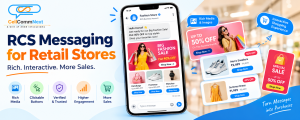
RCS, or Rich Communication Services, can provide a richer messaging experience than a traditional text-only SMS on supported devices and networks.
RCS business messaging in India can be useful for retailers that want to present product information and promotions in a more visual and interactive format.
1. Send Rich Product Promotions
Using RCS, a retail store could create a marketing campaign with images, brief text, and the appropriate call-to-action button.
For instance, an electronics retail store could market some of the headphones through an image, a brief description, and a call-to-action button for customers to click on to see more about the deal.
A fashion store could market its latest collection using images in the form of a carousel, which is facilitated by the messaging app and phone.
This way, the customer can easily grasp what the deal is all about and make the next move.
2. Promote Festival and Seasonal Sales
Indian businesses typically conduct promotions on occasions like Diwali, Holi, Eid, Independence Day, wedding season, and end-of-season discounts.
The RCS messages for retail stores can make use of the above promotions through branded templates, promotion pictures, and actions wherever possible.
For instance, an interior decoration business could inform its customers interested in decorating their homes about a festive collection. Similarly, a cosmetic business could promote its seasonal offer pack to its appropriate customers.
The personalization needs to be according to the customers’ likes and not by assuming what an individual likes.
3. Share Loyalty Program Offers
Through loyalty programs, retailers will be able to communicate their offerings to distinct customer segments.
A company can have specific marketing campaigns targeting its new loyalty members, its regular customers, and those who are about to get rewards.
Messages through RCS can emphasize the available offers and help the consumers visit the appropriate product or loyalty page.
4. Promote Nearby Store Events
Chain stores that have multiple outlets can use customer location preferences in order to communicate their store-related announcements to them.
For instance, a customer registered for alerts on the announcements made by a particular outlet may receive relevant information about the protests, product range launch, or even discounts over the weekend.
Nonetheless, the companies should ensure that the data about the location or preferences used is accurate.
5. Encourage Customers to Explore Products
Interactive RCS messages can be used to support the customer’s transition from discovery of an offer to exploration of the product.
The type of interactive RCS message depends on the service provider and the ability of the devices to handle certain functionalities.
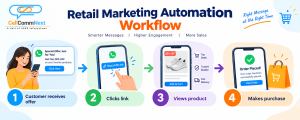
For instance, the retail customer journey can go through the following steps:
Product promotion > Collection view > Product view > Purchase
The capabilities of RCS messages depend on the type of device, carrier, location, and other factors.
Read More—WhatsApp Business API Pricing in India
How Can Retail Stores Use WhatsApp Marketing for Personalized Offers?
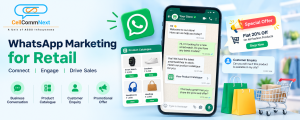
WhatsApp is widely used for personal conversations in India, making it a useful channel for businesses that want to combine promotional messaging with customer support.
With an appropriate business solution, retailers can build automated and conversational campaigns around customer needs.
1. Send Personalized Product Recommendations
Marketing campaigns through WhatsApp for retail stores can be segmented on the basis of customers’ preferences and purchase data.
For instance, a clothes retailer operating on the internet can send recommendations from the latest fashion to those customers who have registered to get such updates.
The text would consist of a brief introduction along with the link and a call-to-action button.
Marketing managers must refrain from sending any recommendation based on some private inference or assumption and must provide a simple mechanism for managing their messages.
2. Automate Abandoned-Cart Reminders
Customers often place items into their cart without finalizing the purchase transaction.
A WhatsApp autoresponder system for retail enterprises could send out a notification in case the shopping cart is abandoned by the customer, depending on the customer’s consent.
A reminder could say:
“Still thinking about your selected items? You can review your cart and check availability here: [Cart Link].”
Implying the limitation of the stock and that the product is on reserve can only be done if that is the true situation. Discounts should also be provided where they exist.
3. Share New Arrivals and Restock Alerts
Retailers can use WhatsApp to notify interested customers about new collections or products that are back in stock.
For example, a customer who requested an alert about a particular product can receive a notification when the item becomes available again.
These messages are more relevant than sending every new product announcement to the entire customer database.
4. Offer Customer Support Alongside Promotions
WhatsApp for Retail integrates the messaging process into CRM, order management systems, and customer service systems, depending on the required integration.
Customers’ queries may include size, payment options, business hours, delivery options, return policies, and promotion eligibility.
Simple queries can be automated, while complicated queries should be assigned to a human agent. It is very important to make the customer know that he/she is dealing with an automated assistant whenever required.
5. Build Post-Purchase Engagement
This does not mean that there is an obligation to stop using retail messaging automation after the completion of a purchase.
According to the permissions and policies, retail businesses can use WhatsApp to notify customers about order details, advice for handling the purchase, questionnaires, and other related information.
This may consist of sending links to manuals for electronic devices or instructions on laundry.
The customer experience can be improved without any additional messaging on discounts.
RCS vs WhatsApp for Business Marketing: Which Is Better for Retail?
RCS and WhatsApp are not identical channels. The right choice depends on the audience, campaign objective, technical setup, and customer communication preferences.
| Feature | RCS Business Messaging | WhatsApp Business Platform |
| Message experience | Rich, interactive messaging on supported devices and networks | Familiar conversational messaging experience |
| Product presentation | Rich cards, images, and suggested actions where supported | Text, media, product links, and supported catalog experiences |
| Customer conversations | Capabilities depend on provider and implementation | Supports two-way business conversations and automation |
| Automation | Can integrate with campaign and business systems | Can integrate with CRM, customer support, and commerce systems |
| Availability | Depends on device, carrier, region, and RCS support | Requires WhatsApp access and a suitable business setup |
| Best-fit use cases | Visual promotions, product discovery, and interactive campaigns | Conversational marketing, customer service, and ongoing engagement |
| Important consideration | Confirm reach, compatibility, and fallback options | Follow opt-in, messaging-template, and platform policies |
When Should Retailers Choose RCS?
RCS may be suitable when a retailer wants to deliver visual promotions, showcase products, and provide interactive actions through supported messaging experiences.
It can be particularly useful for campaigns where product presentation is important, such as fashion collections, electronics, furniture, and seasonal retail offers.
When Should Retailers Choose WhatsApp?
WhatsApp may be a strong option when the campaign requires customer conversations, automated support, product enquiries, order-related updates, or ongoing engagement with customers who have opted in.
It is also useful when customers are more comfortable asking questions before making a purchase.
Should Retail Stores Use Both Channels?
A good number of retail businesses will find that both RCS and WhatsApp can be useful to them in tandem, as opposed to choosing just one of them.
RCS can promote a new season’s collection via a richer promotional message, while WhatsApp can handle queries from customers in case the customer has consented to receive them.
These channels are supposed to complement each other as opposed to pushing duplicate promotions to customers.
SMS is also an independent channel that should be considered by retail businesses in some scenarios.
See the comparison here: RCS vs WhatsApp vs SMS.
How to Build a Retail Messaging Automation Strategy
It should not only use the correct messaging platform but must also ensure that there is an organized process where the customer’s needs are related to the objective of the campaign and its output.
Step 1: Define Campaign Objective
Set your objective for your campaign.
Your campaign objectives may include increasing store traffic, bringing out new products, or recovering from abandoned carts.
Having campaign objectives will make sure that you choose the right message and track its performance.
Step 2: Segment Your Customer Database
Customer data should be organized through properly collected information, including interests, purchases, loyalty program membership, and communication preferences.
Never lump customers together into one segment. A new customer requires different information than an existing customer or loyalty program participant.
Step 3: Select the Right Messaging Channel
Select RCS, WhatsApp, SMS, or a combination based on your marketing objectives, audience coverage, interoperability, customer preferences, and budget.
Before choosing RCS, ensure that it covers devices and networks. For WhatsApp, confirm that your business setup supports the required automation and that your messaging practices comply with applicable policies.
Step 4: Create Useful, Personalized Content
A good personalized offer must tell the recipient why the offer means something to them.
This requires having the right product, the correct terms for the offer, the appropriate call to action, and making it easy for the person to find out more.
Do not simply insert a customer’s name in a generic letter and call it a personalized offer.
Step 5: Set Up Automated Triggers
Common retail triggers include:
- A customer subscribes to promotional updates.
- A product becomes available again.
- A customer reaches a loyalty milestone.
- A permitted abandoned-cart reminder becomes due.
- A scheduled seasonal campaign begins.
- A customer requests product or order information.
Set timing restrictions, suppression policies, and opting-out procedures to avoid sending too many or repeated messages.
Step 6: Test Before Launching
Test message formatting, links, product information, personalization fields, delivery behavior, and customer response flows.
For RCS, verify compatibility and fallback behavior. For WhatsApp, check templates and other requirements applicable to the message type and business setup.
Step 7: Measure and Improve
Review campaign results and compare performance against your original objective.
Test different offers, message formats, timing, and calls to action. Keep changes focused so you can understand which elements contribute to improved performance.
How to Choose the Best RCS Service Provider for Retail Businesses
Choosing a reliable RCS messaging services provider is important for campaign delivery, integration, reporting, and ongoing support.
Retailers comparing a best RCS service provider or an RCS message service provider should consider the following factors.
1. Device and Network Reach
Ask how the provider evaluates supported-device reach, carrier coverage, and fallback options. Confirm what is available for your target audience in India.
2. Personalization and Campaign Features
Check whether the platform supports the content formats, audience segmentation, campaign scheduling, and automation features your retail business requires.
3. Integration Capabilities
Look for integrations with your CRM, e-commerce platform, loyalty system, or customer database where needed.
4. Reporting and Analytics
Understand which delivery, interaction, and conversion metrics are available and how campaign performance can be measured.
5. Compliance and Customer Preferences
Confirm how the provider supports consent management, suppression lists, opt-outs, and applicable messaging requirements.
6. Technical Support and Scalability
Evaluate support availability, documentation, onboarding, campaign-volume capacity, and issue-resolution processes.
Retailers researching available options can explore these resources: Top 10 RCS Messaging Service Providers in India
Compare providers based on verified capabilities, service coverage, support, and suitability rather than rankings alone.
How to Choose a WhatsApp Marketing Solution for Retail
Retail companies exploring WhatsApp marketing solutions must look at the functions necessary for efficient customer communication management.
The following should be considered:
- Configuration of business messaging platform: Ensure that it supports your use cases and that you are planning to deploy on the WhatsApp Business Platform.
- Workflow automation: Make sure that it includes an automated workflow process for handling FAQs, customer inquiries, permitted reminders, and follow-ups.
- Customer Relationship Management Integration: Ensure that it properly manages the information of your customers and also the campaigns.
- Campaign management: It should provide you with all the required features like segmentation, scheduling, and reporting of the campaign.
- Consent Management/Opt-outs: Your customers’ ability to manage their marketing preferences should be ensured.
- Scalability and Support: It should scale to your requirements.
For further research, read Top 10 WhatsApp Marketing Companies in Delhi.
Conclusion
Messaging automation in the retail industry enables businesses to go beyond generic promotions and deliver messages that are more relevant to the shoppers’ journey in a particular store. This messaging application can be used for product promotion that is visually appealing, whereas WhatsApp can be used for communicating with customers, responding to their queries regarding the products, and making contact with them promptly.
In a balanced combination of channels, the retail shop will be able to promote its new products, give some offers, take part in loyalty programs, and all in all, improve customer experience.
The trick is in choosing the right channel for communication depending on goals, making use of the customer data, taking into consideration the preferred mode of messaging, and analyzing the results.
CellCommNext is a business communications provider that offers services such as RCS messaging and WhatsApp Business API.
Learn more about customer messaging and automation using CellCommNext services.
Frequently Asked Questions
What Is Retail Messaging Automation?
Retail messaging automation uses software, customer preferences, and predefined triggers to send relevant messages automatically. Retailers can use it for personalized offers, order updates, loyalty reminders, product recommendations, and customer support.
How Can RCS Messaging Help Retail Stores?
RCS can help retail stores deliver rich, interactive messages featuring images, promotional content, and action buttons on supported devices and networks. It can support product discovery, seasonal promotions, and personalized offers.
Is WhatsApp Marketing Effective for Retail Businesses?
WhatsApp marketing can help retailers share relevant promotions, answer customer questions, automate permitted reminders, and maintain customer communication. Results depend on audience relevance, consent, campaign quality, and the shopping experience.
What Is the Difference Between RCS and WhatsApp for Retail Marketing?
RCS focuses on rich messaging experiences through supported devices and networks, while WhatsApp supports familiar business conversations and automation within its platform. The right option depends on audience reach, campaign objectives, and required features.
How Can Retailers Choose an RCS Messaging Services Provider?
Retailers should compare reach, device compatibility, campaign features, integrations, reporting, compliance support, scalability, and customer service. They should verify the provider's capabilities before launching campaigns.