
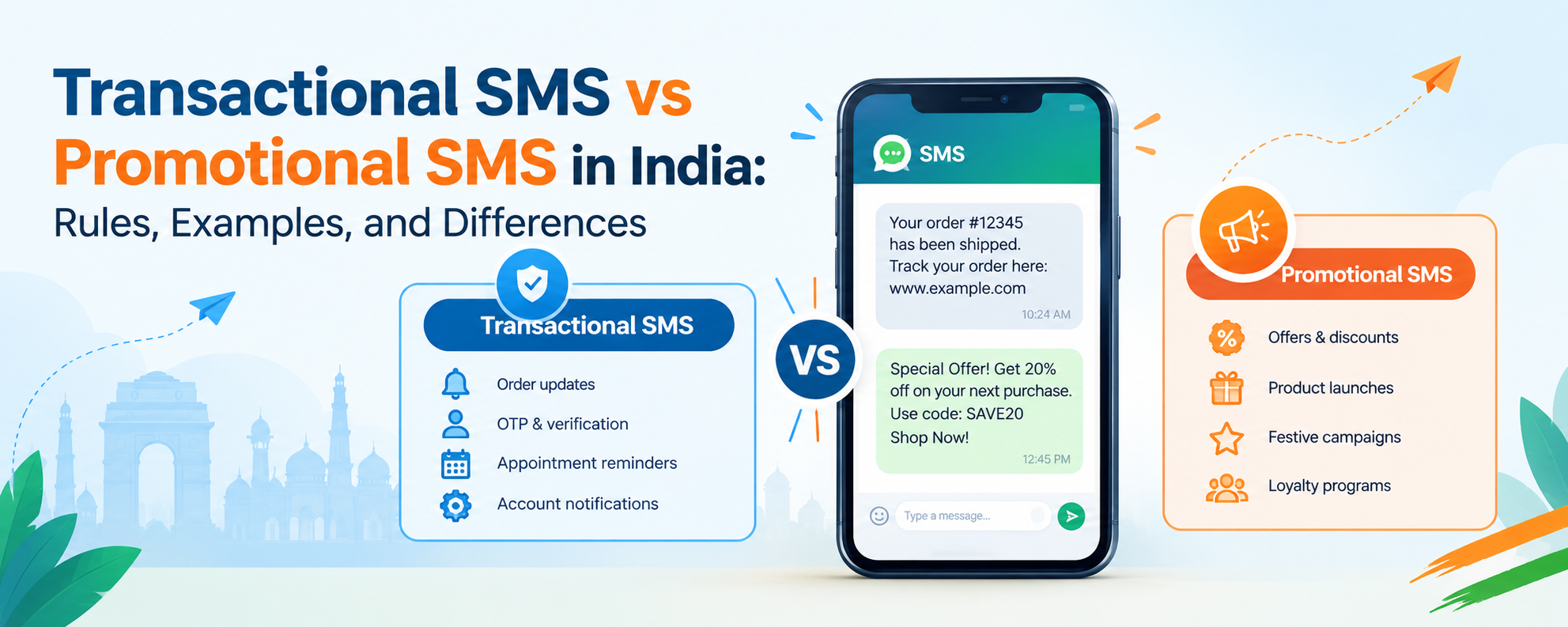
Indian companies make use of SMS for verification of their customers’ accounts, confirmation of orders, updates regarding payments, announcements about offers, and promotions of products. Nonetheless, all business-related SMS do not have the same objective. There is a need for transactional SMS and promotional SMS that are different from each other.
Choosing the correct SMS category helps businesses communicate more effectively, organize their messaging campaigns, and follow applicable telecom regulations.
In this guide, we explain transactional SMS vs promotional SMS in India, including their differences, examples, applicable TRAI and DLT requirements, business use cases, and how to choose a reliable bulk SMS service provider in India.
What Is Transactional SMS?
Transactional SMS is the kind of message sent to aid in a customer’s transaction, account transaction, authentication, or even a current service. The message usually carries critical information that helps the customer perform some action or know about a service.
A good illustration could be when an e-commerce company sends a purchase confirmation message after a customer has purchased some goods online. This may also be the case of a banking app sending a transaction alert or a website sending a one-time password (OTP).
Examples of Transactional SMS
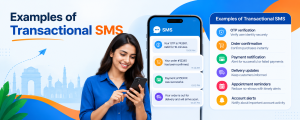
- OTP authentication: One-time password for login or authentication.
- Confirmation of Order: Confirmation that an order has been placed by the customer.
- Notification of Payment: Notification that relates to payment or the payment status.
- Status Updates of Delivery: Notification on the status of the delivery of goods.
- Appointment reminders: Reminder of an appointment made by the customer.
- Account notifications: Important notification regarding the account or service.
Example of a transactional SMS:
“Your order #45821 has been confirmed. We will notify you when your package is dispatched. Thank you for shopping with us.”
The message is informative in nature and is related to the existing order rather than advertising any new product.
Important: The classification of a message is decided based on the intent behind it along with the telecommunication regulations that apply to it, and not because of whether the sender calls it transactional.
What Is Promotional SMS?
SMS promotion involves the advertisement of various kinds of products and services through messages such as discounts, events, offers, and others. Businesses send promotional bulk SMS to attract new customers and motivate old customers to act.
Promotional SMS works effectively for businesses such as retailers, educational institutions, real estate business firms, travel agencies, and many more.
Examples of Promotional SMS

- Discount messages: Informing customers about a sale or discount offer.
- New product launch: Informing customers about new products or services.
- Event invitation: Promoting the upcoming exhibition or business event.
- Lead generation: Encouraging the potential customers for quotations.
- Seasonal marketing: Promoting the festival offers or season specials.
- Introduction of brand: Informing about a business to the eligible audience.
Sample of promotional SMS:
“Festive Sale is here! Enjoy exciting offers on selected products this week. Explore our latest collection today. T&C apply.”
This message encourages customers to make a purchase, so it serves a promotional purpose.
Transactional SMS vs Promotional SMS: Key Differences
The main differentiation between transactional SMS and promotional SMS is based on intent. Transactional SMS typically includes information regarding transactions, while promotional SMS relate to advertising and sales of products.
| Comparison | Transactional SMS | Promotional SMS |
| Primary purpose | Transaction and service updates | Marketing and advertising |
| Common examples | OTPs, order updates, account alerts | Discounts, offers, product launches |
| Typical audience | Relevant customers or users | Eligible marketing audiences |
| Timing | Triggered by an action or service event | Scheduled according to a campaign |
| Customer consent and preferences | Depends on the message type and applicable rules | Promotional consent and customer preferences are important |
| Telecom classification | Must match the applicable service or transactional category | Must match the applicable promotional category |
| Common business goal | Inform, verify, or update | Promote, engage, or generate sales |
| Delivery requirements | Applicable registration, template, and routing requirements | Applicable registration, consent, preference, and template requirements |
P.S. The exact classification, routing rules, sending limitations, and delivery requirements should be determined by the telecom operator or messaging provider according to the existing legislation. Don’t think that transactional SMSes are exempt from any restriction at all.
TRAI Rules for Transactional and Promotional SMS in India
Any business sending any commercial communication in India shall have to abide by the regulations laid down by TRAI (Telecom Regulatory Authority of India), which include the Telecom Commercial Communications Customer Preference Regulations (TCCCPR).
The framework of regulations includes unsolicited commercial communication, customer preference, sender registration, headers, content templates, and responsibilities of both business and telecom service providers.
There have been amendments made to the framework in September 2026. It is suggested that businesses review the directions and operator requirements first.
1. Register as a Principal Entity
Businesses sending regulated bulk communications may need to register as a Principal Entity (PE) with their telecom service provider.
Registration requirements apply to businesses using bulk SMS for relevant commercial communications, including service messages and OTP-related messaging.
2. Register the Appropriate SMS Header
A header identifies the registered sender of a commercial message. Businesses should use the appropriate registered header and follow the relevant operator’s requirements for the message category.
3. Register SMS Content Templates
Message templates must be registered where required. The content sent should comply with the registered template and applicable variable-content rules.
Businesses should avoid making unapproved changes to registered templates, particularly when adding offers or promotional wording to service-related messages.
4. Follow Consent and Customer Preference Rules
Promotional communications must follow applicable consent and customer preference requirements. Businesses should maintain reliable records of permission and respect applicable opt-outs and DND preferences.
The rules for service-related messages differ according to their purpose and the applicable category. A business should not treat a marketing message as a service message simply to bypass promotional restrictions.
5. Use an Appropriate Messaging Route
It is important for companies to ensure that their bulk SMS service providers have the right registered route for the specific type of message they wish to send out.
The wrong category could cause filtering, blocking, or complaints against the message.
Official reference: TRAI—Advice to Senders and TRAI—TCCCPR Regulations
When Should Businesses Use Transactional SMS?
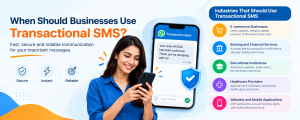
Transactional SMS is suitable in situations where the customer requires quick information regarding any transaction, account, or service.
E-commerce Firms
Order confirmations, shipping status, delivery notifications, and payment confirmations can be communicated through the message service.
Banking and Financial Institutions
Service notifications will notify customers of any account-related actions or payments and requests for authentication based on the regulations of the financial industry and telecom sector.
Educational Institutes
Various confirmations, applications, and exam notifications could be sent by schools and colleges and any educational platform through the message services.
Healthcare Providers
Messages about scheduling confirmations may be sent out from hospitals and other medical centers.
Websites & Mobile Applications
Companies can make use of SMS OTP for user authentication, login, and account verification purposes.
When Should Businesses Use Promotional SMS?

Promotional SMS can be used in marketing activities where it becomes essential to notify the target audience about the products/services/offers.
Retail & E-commerce
Companies can market their seasonal offer packages, new range of products, and launches by using SMS.
Real Estate
Property companies can use SMS to promote the launch of new projects/exhibitions and offers.
Education & Training
Institutes for training can use promotional SMS for advertising new courses and information sessions.
Travel and Hospitality Industry
Discounts can be offered by the travel agency for holidays and seasonal times.
B2B Organizations
Business services agencies may send invitations for events, product demos, service announcements, and promotional emails to their business contacts.
All of these use cases require businesses to ensure their compliance on several aspects.
Transactional SMS vs Promotional SMS: Practical Examples
Take, for instance, a business dealing with sales online. Both types of SMS can be used by such a firm for various reasons.
Scenario 1: Order Placed by Customer
The company sends the client an order confirmation along with the order number and delivery information. This type of communication is generally service-oriented.
Scenario 2: Discount Offered by Firm
The firm sends a message to the customer offering a discount code on the next purchase. Such communication is promotional in nature.
Scenario 3: The customer receives an OTP
The firm then uses a single-use password for login verification. This is an authentication-related message, subject to the applicable classification and rules.
Scenario 4: The company combines an order update with an offer
The company sends an order update and adds, “Buy another product today and get 20% off.” The additional information in the message can influence the type of the message. The organization has to clarify the approved method for the message from the messaging provider before it is automatically sent out as a service message.
As shown above, it is as important to know what the SMS is about as who sends it.
Also Read: What Is DLT Registration?
How to Choose the Right Bulk SMS Service Provider in India
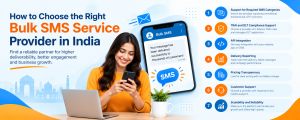
For companies that require management of both service alerts and promotions, it becomes essential to choose a proper bulk SMS service provider in India.
Before choosing a provider, evaluate the following factors.
Support for Required SMS Categories
Check if the provider is able to send message categories required by your business including OTPs, service-related messages, and promotional SMS.
TRAI and DLT Compliance Support
Ask about principal entity registration, header registration, template registration, consent requirements, and support for applicable regulatory changes.
API Integration
When accessing through websites, CRMs, ERPs, or a mobile app, ensure that an SMS API service exists on the provider’s side.
Delivery Reporting
Ensure there are delivery reports, information about failed deliveries, and tools for monitoring the delivery process of your campaigns.
Keep in mind that a sent message is not equal to a delivered message. Find out how delivery statuses are provided and the reasons why delivery may be affected.
Price Comparison
Minimum top-up requirements and any other costs.
The lowest rate does not necessarily mean the lowest price.
Customer Support
Consider a provider that would be able to assist with integration, registration, template problems, delivery issues, and campaign creation.
Scalability and Reliability
Think about the ability of the service provider to cope with your volume requirements in the peak period. Request information based on promises and reports instead of getting lured by mere marketing techniques.
How to Compare Bulk SMS Providers in India
Businesses researching a bulk SMS service provider in India may encounter many companies offering similar services. Instead of relying only on a “top 10 bulk SMS provider” list, compare providers using practical selection criteria.
| Evaluation factor | What to check |
| Compliance | Registration and template support |
| Message categories | Required service and promotional routes |
| Integration | API documentation and technical assistance |
| Reporting | Delivery status and campaign reports |
| Pricing | Total cost and additional fees |
| Support | Response time and troubleshooting |
| Scalability | Ability to handle expected message volumes |
For companies in Delhi NCR, it will be equally useful to compare local customer support and onboarding services while selecting bulk SMS services in Delhi.
Instead of ranking the top 10 bulk SMS service providers in India without any supporting evidence, select one according to the criteria and evidence.
Why Choose CellCommNext for Bulk SMS Services?
CellCommNext offers bulk SMS services for businesses that need to communicate with customers through service notifications, OTPs, and promotional campaigns.
It is a top 10 bulk SMS service provider in Delhi, offering messaging solutions for businesses across different industries, along with features such as API integration, campaign management, delivery reporting, and DLT-related support.
With regard to CellCommNext for businesses, we can talk about your messaging needs and make sure we are clear about the registration process that applies to you, the message categories available, integration methods, pricing, and delivery reports prior to proceeding.
For organizations that require account messages, user verification, customer order updates, or eligible marketing campaigns, selecting the right SMS category is a vital first step.
Conclusion
A good understanding of transactional SMS and promotional SMS in India will help businesses choose the best way of communicating with their customers.
Transactional SMS is normally utilized for authentication, confirmation, and service update purposes, whereas promotional SMS enables businesses to market their offers to the targeted audience. The fact that the corresponding rules and templates and process of message sending are followed needs to be considered in both cases.
In order to choose a bulk SMS service provider, there are several issues that need to be taken into consideration. Are you interested in bulk SMS solutions for your company? Find out more about CellCommNext’s Bulk SMS Services in India.
Explore CellCommNext to learn more about its business communication solutions.
Frequently Asked Questions
What is the difference between transactional SMS and promotional SMS in India?
Transactional SMS generally communicates information related to a transaction, account, or existing service. Promotional SMS is intended to advertise products, services, offers, or marketing campaigns. The applicable telecom classification depends on the message's purpose and current rules.
Is transactional SMS allowed for DND numbers in India?
The answer depends on the message category, purpose, applicable regulations, and operator requirements. Businesses should not assume that every message labelled transactional can be delivered to every DND-registered number. Confirm the permitted route and restrictions with your telecom provider.
Is DLT registration required for bulk SMS in India?
Businesses sending regulated bulk communications generally need to complete the applicable principal entity registration and follow requirements for registered headers and content templates. Confirm the current requirements with your telecom service provider and the relevant TRAI guidance.
Can a business send promotional SMS without customer consent?
Businesses must follow applicable consent and customer preference rules for promotional communications. They should not send unsolicited marketing messages or use a service-message category to bypass promotional restrictions.
Can transactional SMS include promotional offers?
Adding marketing content to a service-related message can affect its classification. Businesses should confirm the permitted content, template, and routing requirements before sending combined messages.